Digital Technology Learning in a Non-High-Tech Environment
[et_pb_section fb_built=”1″ _builder_version=”3.19.17″][et_pb_row _builder_version=”3.19.17″][et_pb_column type=”1_2″ _builder_version=”3.19.17″][et_pb_image src=”https://www.ukdw.ac.id/en/wp-content/uploads/sites/2/2019/12/Digital-Technology-Learning-in-a-Non-High-Tech-Environment.jpg” _builder_version=”3.19.17″][/et_pb_image][/et_pb_column][et_pb_column type=”1_2″ _builder_version=”3.19.17″][et_pb_image max_width=”84%” src=”https://www.ukdw.ac.id/en/wp-content/uploads/sites/2/2019/12/Digital-Technology-Learning-in-a-Non-High-Tech-Environment-2.jpg” _builder_version=”3.19.17″][/et_pb_image][/et_pb_column][/et_pb_row][et_pb_row _builder_version=”3.19.17″][et_pb_column type=”4_4″ _builder_version=”3.19.17″][et_pb_text _builder_version=”3.19.17″]
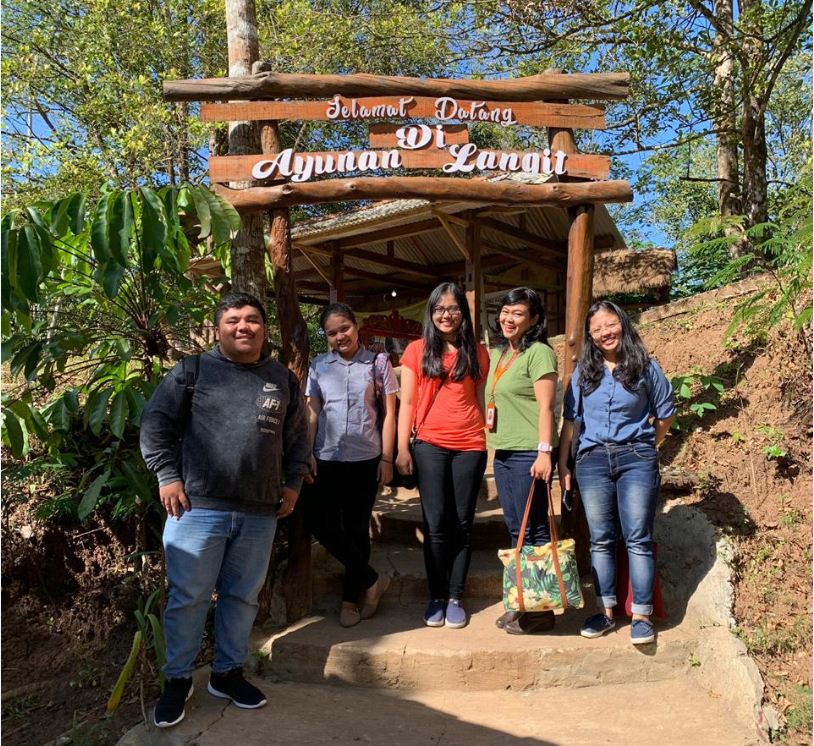
As a concern for community development, the English Language Education Department of UKDW has conducted an English training in a Community Based Tourism (CBT) site, Ayunan Langit in the area of Menoreh Mountain Range of Kulon Progo district, in Yogyakarta municipality. Followed by 8 participants, the program lasted for 3 months, from May to July and extended to November 2019.
The area is characterized as a low-tech learning environment where learners could not always depend on a stable internet connection and internet access was not always available due to the geographical condition of the sites. Teaching and learning processes during the program were conducted in the site where the learning environments provided limited technological tools, such as the internet, computer, projector, or other electronic devices, to facilitate learning. However, in spite of the limited access to the internet and other technological devices, online classes were conducted by using WhatsApp Group (WAG) as a discussion room allotted for the purpose of framing the discussion on certain topics and providing enrichment videos under the topics being discussed in class. These online meetings were used to supplement the face-to-face meetings which were held once every two weeks.
On the initial visit, common necessities of learning oral English to facilitate their jobs and assignment as CBT workers for ticketing, guiding guests, adventure assistants, food sellers, and parking attendants were identified. They began to realize the need for being able to speak English. As more foreigner visitors come, they admitted that they could have served them better, given enough English training both to effectively understand what they mean and to give appropriate responses. Ticketing staff, for instance, uttered the need to explain the facilities and attractions visitors might be interested in. Safety staff admitted that visitors often asked questions related to risks and safety procedures. They had been relying on common vocabulary uses for basic communication, despite struggling to string the words into a comprehensible complete idea in accordance with English Syntax rules. Body language and gestures had been their handy communication strategies.
Given instruction to retell their personal info, to describe their CBT sites, or to have role-played of customer-visitors, it was found out that about most of them are at the level of low intermediate to intermediate, as observed within three criteria of oral competence; fluency, accuracy, and comprehensibility. They were able to converse in English with few halts in fluency and many grammatical mistakes, yet able to produce comprehensible sentences and convey what they mean. The rest were at the level of elementary, facing problems mostly on the use of common vocabulary for daily conversation purposes.
To facilitate language skill practice and to give sufficient language input, online material was prepared and designed. Information about availability and access to internet facilities was sought while conducting the need analysis. The results suggested that the face-to-face meeting could be enriched by means of online material using a familiar platform. As WhatsApp communication is very common among the participants, two groups of the classes were made as a pseudo-E class facility to post material, have an online discussion, and send video lessons for English skill practice. The media was well received by both groups and all participants could use this platform with ease. Three videos containing samples of conversations along with grammar lessons and its extended use were posted every 2 weeks, after every face-to-face meeting. Each topic lasted for about 7-8 minutes consisting of topic introduction, conversation and drama, grammar lessons, and extended use of the language points.
Reflection and observation of the class indicated firstly that their motivation for learning English is due to increasing awareness to communicate with foreigners. They need English to facilitate their jobs as CBT staff or operators. More foreigners coming to the CBT site would increase their economy and income. It has been acknowledged that motivation is an important factor in foreign language learning (FLL) success. These motives could be categorized as instrumental ones as they used to describe learners who have immediate or practical goals for the use of the language such as a job or an examination. Secondly, participation and intensity of online discussions and watching the online media were quite interesting, despite their condition on limited internet access. The students were observed to be active and engaged during online conversations. Lastly, they feel more confident to speak English. The final assignment to make vlog appeared to be rewarding for them and the facilitators. They made short videos on various topics, such as local dance Encling, traditional dish Gebleg, a tutorial on planting coffee, and many more.
It is true that English for Specific Purposes for CBT workers in this activity addresses their professional needs to serve foreign guests. Despite their situation in a remote area, elaboration of face-to-face classes and online material using a simple app appears to facilitate the instruction. However, above all the constraints, they enjoy the lesson and more importantly, they feel more confident to speak English. They embrace technology and live with it. [Widiatmoko]
[/et_pb_text][/et_pb_column][/et_pb_row][/et_pb_section]