
E-commerce Trend and the Significance of Technology in Digital Era
[et_pb_section fb_built=”1″ _builder_version=”3.19.17″][et_pb_row _builder_version=”3.19.17″][et_pb_column type=”4_4″ _builder_version=”3.19.17″][et_pb_image src=”https://www.ukdw.ac.id/en/wp-content/uploads/sites/2/2020/01/FTI-UKDW-Public-Lecture-E-commerce.jpg” _builder_version=”3.19.17″][/et_pb_image][/et_pb_column][/et_pb_row][et_pb_row _builder_version=”3.19.17″][et_pb_column type=”4_4″ _builder_version=”3.19.17″][et_pb_text _builder_version=”3.19.17″]
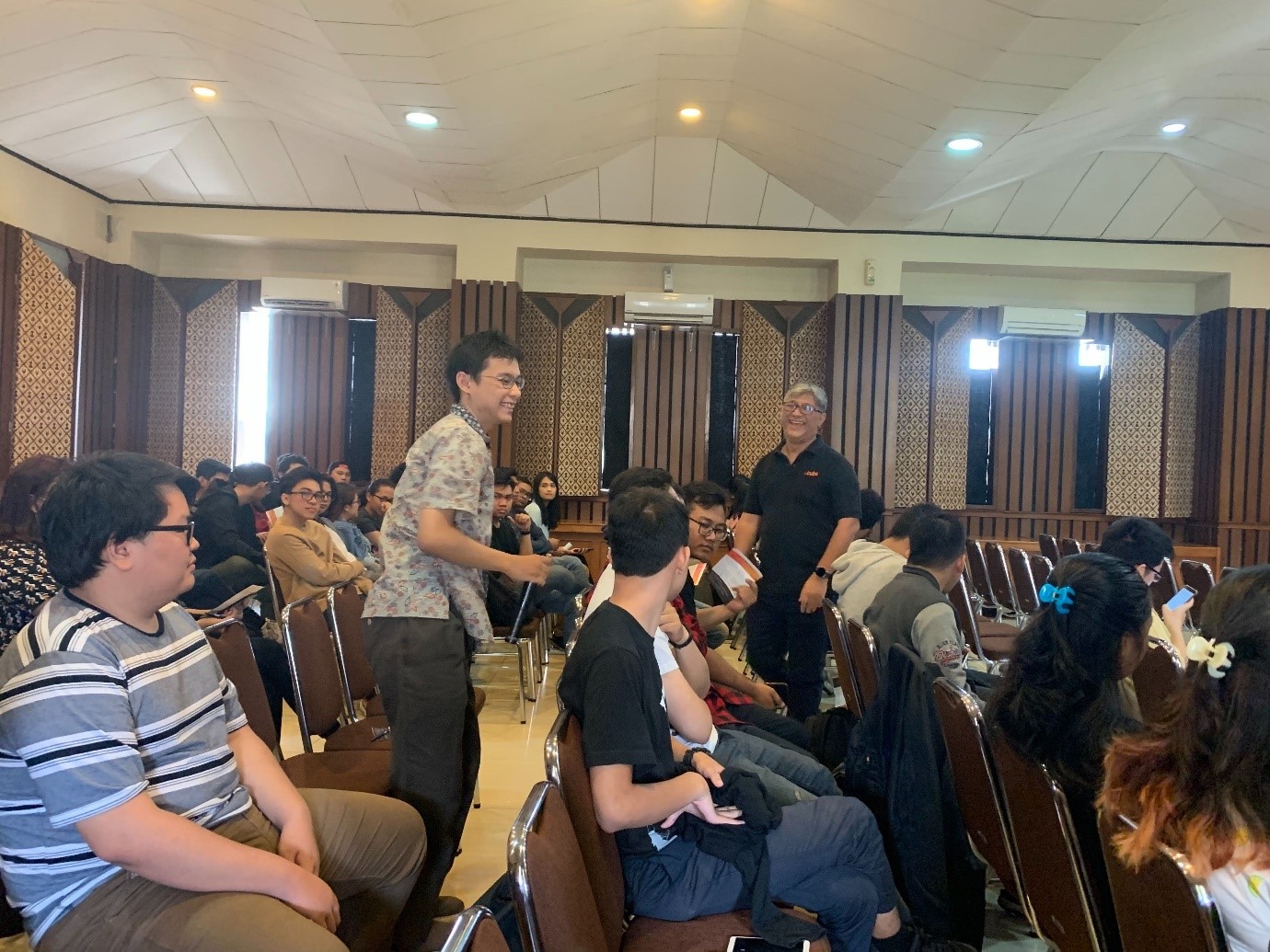
The Faculty of Information Technology of Universitas Kristen Duta Wacana (FTI UKDW) together with PT Inovasi Informasi Indonesia (ICUBE) conducted a public lecture titled “The Impact of New Customer Behavior in the Digital Era and the Role of a Good eCommerce Platform” on Friday, December 6, 2019. This public lecture aimed to share knowledge about e-commerce and the technology inside.
Taking place at Rev. Harun Hadiwijono Seminar Room UKDW, the lecture was delivered by Muliadi Jeo (Founder & CTO of ICUBE) and Paulus Bimo (Senior Backend Developer). Bimo, who is FTI UKDW graduate, said that ICUBE and UKDW have a special relationship because half of the ICUBE team are alumni of this faculty. “UKDW is the first campus we visit for the ‘ICUBE Goes to Campus’ program,” he stated.
The first session, which was delivered by Muliadi, focused on discussing e-commerce. With more than 20 years of experience in this industry, Muliadi talked about the evolution of e-commerce from time to time and the current trend as well as the projected coming trend. In his talk, Muliadi analyzed eight e-commerce trends, which are mostly have been performed in developed countries. Trends such as self-service, augmented reality (AR), virtual reality (VR), internet of things (IoT), machine learning, and artificial intelligence (AI) are some examples of how the advance of technology holds a big role in the electronic commerce industry.
“We’ve changed, almost everything has changed. It’s all because of technology,” said Muliadi. Conventional stores that fail to adapt will be left behind. Borders, a big bookstore in the US that was out of business, is one example. A 40-year long-established brand could collapse by the strike of digitalization flow. Ironically, it is only one out of hundreds if not thousands of cases.
Is this online platform the only answer to this problem? In some cases, this offline-online platform phenomena looks scary. Some will choose either to stay offline or go online. The rising number of digital literate buyers does not guarantee they depend only on the online method. Combining offline and online methods are more than just a choice, it might be a necessity.
“Customer today buy experiences not just products,” said Muliadi. As an e-commerce expert, he believes that the advance of technology has changed consumer behavior. The “instant” culture is a logical consequence of technology advancement, which influence the pattern of consumer. Customers demand an easy, efficient, fast, and precise purchasing process. From this point, the omnichannel concept is started to grow.
Omnichannel does not only talk about how many purchasing channels are used but more about how a customer journey will finish smoothly. For example, to buy a pair of shoe X, a customer can choose any channel to do the transaction. The customer can go to the offline store or buy it through the e-commerce website, the choice is in costumer’s hands. Omnichannel talks about different choices or methods for customers to buy a product, where the focus is on the customer themself. It means that customers become the center of the circle and the flow of purchasing, which subsequently will optimize the consumer experience.
In the second session, Bimo emphasized the significance of technology which is implemented in e-commerce. The more flexible, solid, and updated the platform being used, it will show higher performance. An e-commerce website is not only rated by the interface, but it also has many features inside and customization that should be maintained.
The students also learned about various popular e-commerce platforms used by millions of e-commerces around the world. There are Magento, Shopify, BigCommerce, WooCommerce, and many more. Bimo specifically focused on discussing Magento and the features inside its back-office. For example, Bimo explained about OMS (Order Management System) as an important point in the purchasing flow. Presenting a case study of www.9to9.id, Bimo explained the flow of the customer journey, starting from the purchasing process to shipping. It may look simple but in fact, it needs a well-integrated system to generate a flawless process and maintain customer experience.
This event gave new insights and perspectives. A fresh e-commerce topic has brought a positive interest to students. “We hope to be able to continuously give contributions to education, especially with the collaboration with UKDW in the next agenda and opportunity,” said Muliadi closing the public lecture.
[/et_pb_text][/et_pb_column][/et_pb_row][/et_pb_section]