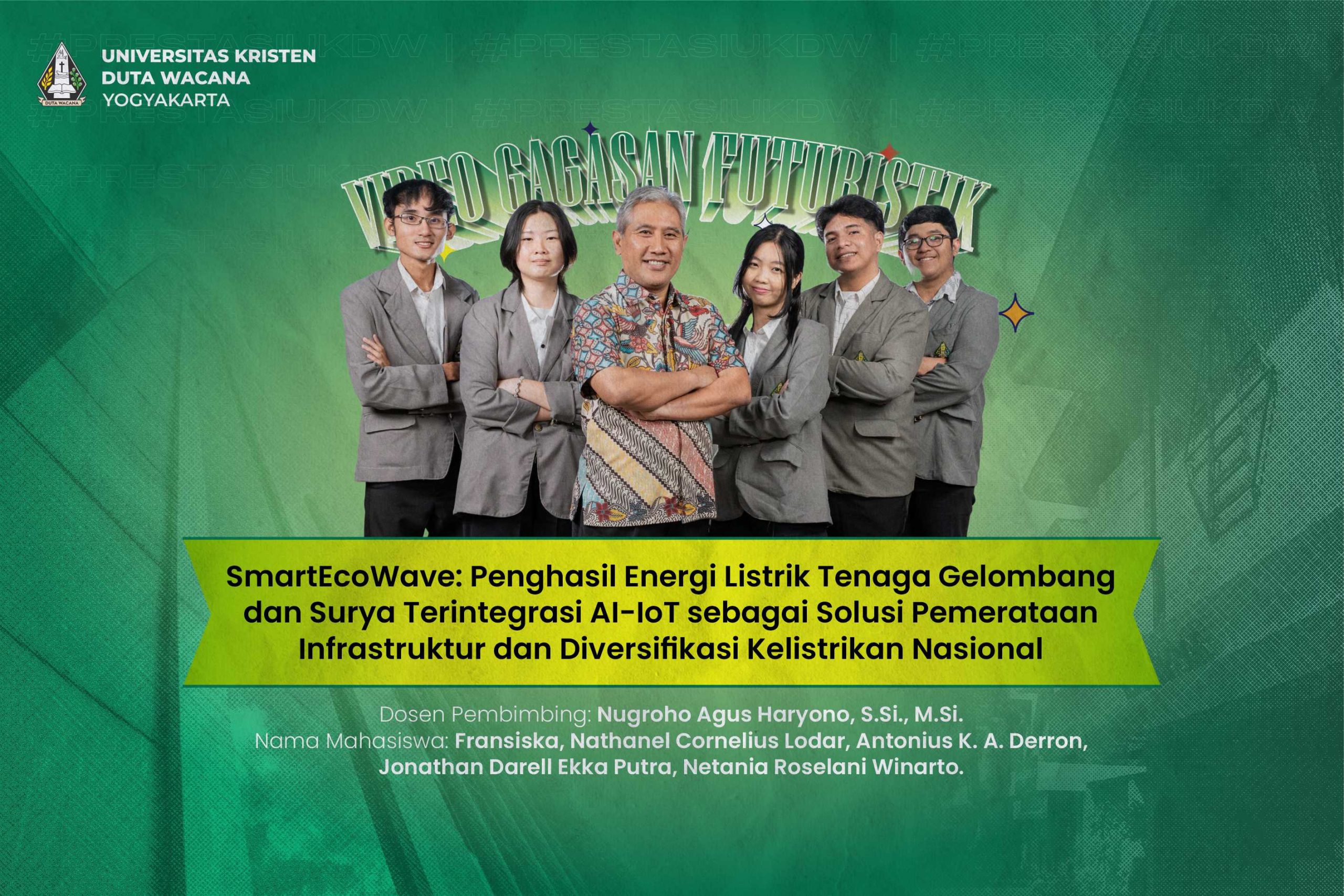
UKDW Students Propose “SmartEcoWave” Renewable Energy Innovation for Remote and Border Regions
 YOGYAKARTA — Indonesia’s continued reliance on fossil-fuel-based power generation—particularly coal—remains a major hurdle in the country’s transition to clean energy. This is despite Indonesia’s vast potential for renewable energy sources such as solar and ocean wave energy. Electricity access disparities, especially in remote, frontier, and outermost (3T) regions, further exacerbate the challenge of energy equity.
In response, five students from Universitas Kristen Duta Wacana UKDW) Yogyakarta have developed an innovative renewable power system called SmartEcoWave. Their proposal, presented as a futuristic concept video, won funding under the 2025 Student Creativity Program – Futuristic Concept Video Scheme (PKM-VGK), a national competition organized by the Directorate of Learning and Student Affairs, under the Ministry of Education, Science, and Technology of the Republic of Indonesia.
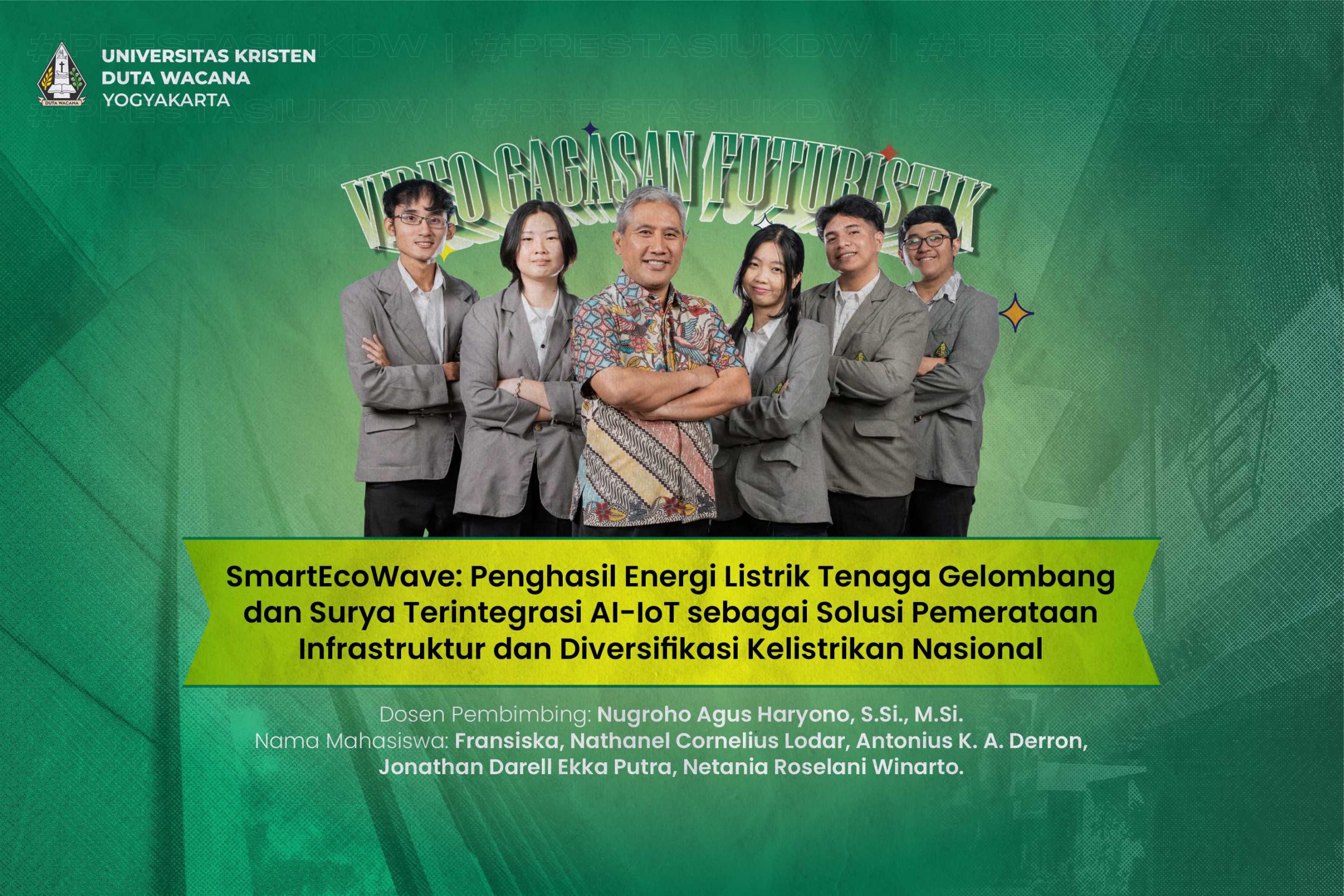
The team—comprising Fransiska, Nathanel Cornelius Lodar, and Antonius Kiya Ananda Derron (Informatics), along with Jonathan Darell Ekka Putra and Netania Roselani Winarto (Accounting)—designed SmartEcoWave as a self-sustaining modular power system that harnesses both solar and ocean wave energy to generate electricity.
“This idea emerged as a response to unequal electricity distribution across the country and the overdependence on fossil fuels,” said team leader Fransiska. “SmartEcoWave is designed as a floating, modular platform that can operate along coastlines and in remote islands not connected to the national grid.”
Smart Integration of AI, IoT, and Renewable Power
SmartEcoWave combines AI (Artificial Intelligence) and IoT (Internet of Things) technologies to maximize system efficiency and functionality. The IoT component enables the conversion of ocean wave motion into electrical energy, while the AI component processes data on weather, temperature, and wave conditions to predict maintenance needs and automatically regulate energy output.
Solar panels and wave energy converters are arranged in a parallel configuration to ensure power supply continuity—even if one energy source is underperforming. Environmental sensor data is transmitted via the cloud using IoT connectivity, allowing real-time remote monitoring and control.
This innovation not only offers a technological solution but also supports Indonesia’s broader goals for an equitable and sustainable energy transition, especially in regions long neglected by national infrastructure development.
Recognition and Future Plans
“We’re very grateful for the funding support,” said Fransiska. “The UKDW PKM team was incredibly helpful and supportive throughout the proposal and selection process.”
The team’s success was also shaped by the guidance of faculty advisor Nugroho Agus Haryono, S.Si., M.Si., a lecturer in UKDW’s Informatics program. “The students demonstrated great enthusiasm and a strong willingness to grow,” he said. “They actively engaged in every mentoring session and showed openness to feedback throughout.”
As a next step, the team plans to produce a short video that highlights the national electricity distribution challenges and showcases SmartEcoWave as a visionary solution. The aim is to inspire young innovators and policymakers to support renewable energy development in Indonesia. [humasukdw/tr.drr]